Before you buy an AI sales tool, what should you write down first?
An AI tool can only repeat what your company already knows and agrees on. Here's the boring step we took at IMPACK long before AI, with an answer card template and a 10-day sprint plan.

Is someone at your company pushing to “do something with AI” in sales? Are you wondering whether you’ll fall behind if you don’t buy a tool this quarter?
When I was selling packaging machines at IMPACK, we paid Google for leads. It brought us about 1 lead a month. Later we switched the ads off, and about 8 organic leads a month were finding us on their own. They were better leads too.
No software did that. A habit did. And it’s the same habit that decides whether an AI sales tool helps you or just spreads confusion faster. I’ll be honest: this article will probably talk you out of buying something this month.
The short answer: An AI tool can only repeat what your company already knows and agrees on. Before you buy one, write down your top 10 buyer questions, each with an agreed answer, an owner, the proof, its limits and the date it was last reviewed. It takes about 10 working days of short sessions, and it pays off even if you never buy a tool.
What did we write down at IMPACK, and what did it change?
We wrote down the questions buyers actually asked us, and we answered them plainly. Price, lead time, what can go wrong, how we compare. Before an answer went out, the people who knew the machines agreed on it.
The method came from They Ask, You Answer. At IMPACK we had coaching on that framework to build our own team. I later adapted it for industrial, long-cycle sales, and it became the Fuel Supply part of the Production Visibility OS (PVOS).
Three things changed:
- We talked about price. We put a pricing page on our website, at a time when almost nobody in our industry did.
- We stopped paying for ads. The content brought buyers to us, so Google Ads weren’t needed anymore.
- New reps sounded like our best expert. Because the answers were written down, a newer salesperson could give the same answer our most experienced engineer would have given.
That last point is the one to hold on to. The written, agreed answer was the asset. The website, the videos and the emails were only ways to deliver it.
Why does this matter more once AI is in the picture?
Because AI is a delivery system too. A very fast one.
I’ve watched deals stall in a specific way. The expert explains something brilliantly on a call. Two days later the follow-up email says “just checking in.” What the expert said never made it into writing.
Give that team an AI writing tool and you get a longer, more polished “just checking in,” in seconds. Speed was never the problem. The missing answer was.
Three lessons from long before AI still decide whether a tool helps you:
- A person approves every technical claim. One wrong sentence about capacity, tolerances or lead time can cost a deal or start a warranty dispute.
- Expert knowledge is the scarce input. Getting it out of people’s heads is the hard part, not the software.
- Every answer needs a source someone can point to. An answer with no source is a guess with good grammar.
What should an agreed answer card contain?
An agreed answer card is one page per buyer question. It has six fields:
| Field | What goes in it | Why it matters |
|---|---|---|
| Question | The buyer’s exact words | You answer what they ask, not what you wish they asked |
| Agreed answer | 3 to 6 plain sentences | Same answer from every rep, every time |
| Owner | One named expert | Someone keeps it true |
| Proof | A test, a drawing, a reference, a video | So the answer can be defended to the buyer’s engineer |
| Limits | When the answer doesn’t apply | This is where trust comes from |
| Last reviewed | A date | Old answers quietly become wrong answers |
The field most teams skip is Limits. It’s also the one buyers value most. “This applies up to X. Above that, we need to look at your line” is a better answer than a confident one that turns out to be wrong.
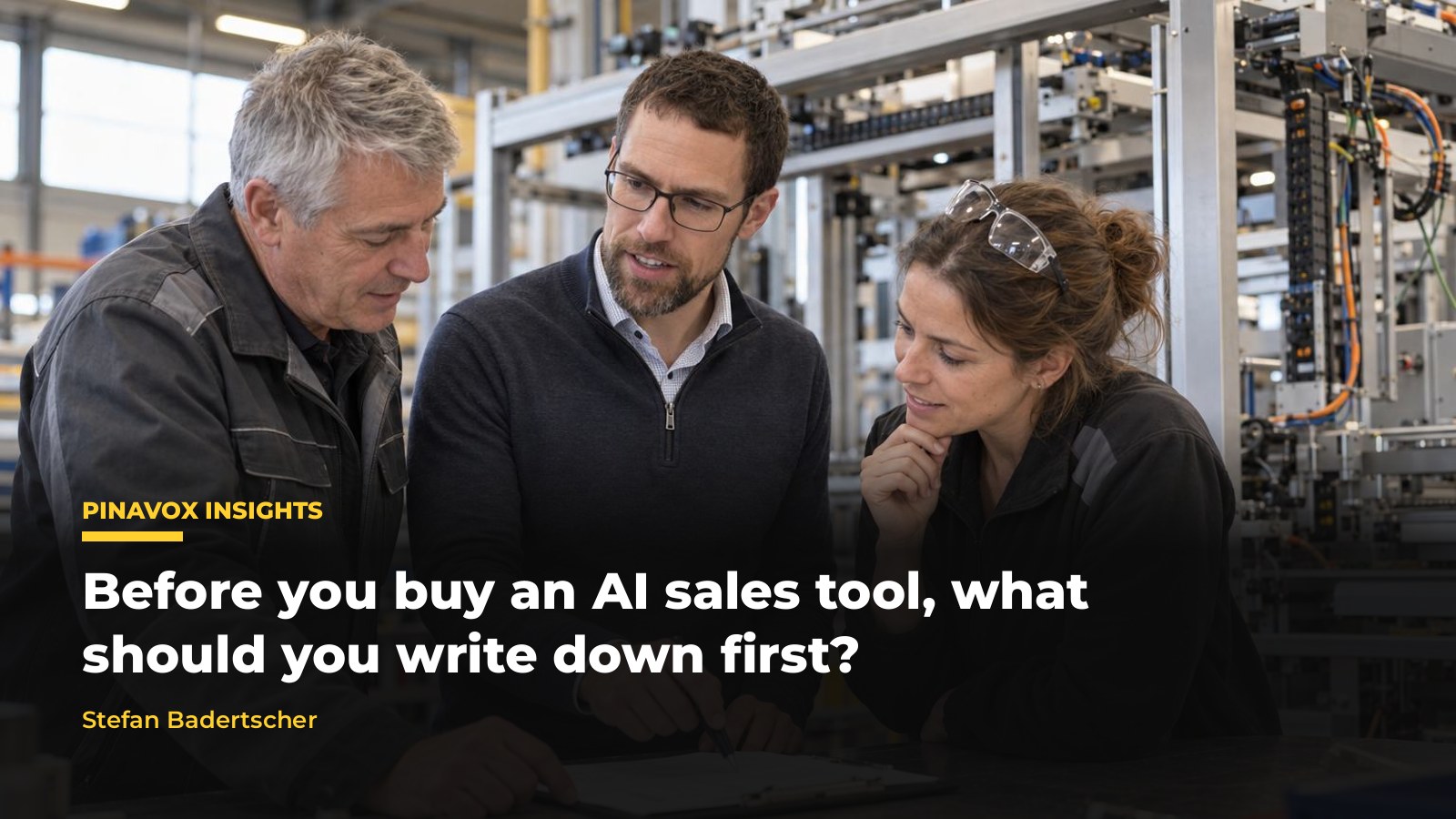
 An expert checks what the AI assistant drafted before it goes anywhere: AI drafts, a person approves every technical claim. (AI-generated image)
What does a filled-in card look like?
Here’s one card for a typical machine builder question. The machine, numbers and names are an illustration, not IMPACK data.
Question: “How long does it take from order to a running machine?”
Agreed answer: For a standard case packer, plan on 16 to 20 weeks from signed order to the factory acceptance test, and 1 to 2 weeks on site for installation and start-up. The biggest variable is how fast we receive your final box samples and layout approval. Custom formats or a new robot cell add 4 to 8 weeks.
Owner: Head of Projects
Proof: Delivery dates of the last 12 standard projects (internal list); project timeline in the buyer’s guide.
Limits: Doesn’t apply to lines with more than 3 new formats, or when parts lead times are unusual. In those cases the project lead gives a dated plan after the kick-off.
Last reviewed: [date], by the Head of Projects and the Sales Manager.
Notice what it does. It gives a real range. It names the variable the buyer controls. And it says honestly where the answer stops.
What can you do in the next 10 working days?
You don’t need a platform. You need 10 short sessions and two experts per question. Here’s the sprint plan we use with clients:
| Day | What you do | Who | Time |
|---|---|---|---|
| 1 | List every question you heard from buyers in the last 3 months. Pick the 10 asked most. | Sales lead and 2 reps | 45 min |
| 2 | Write a rough answer to questions 1 and 2 | Best expert | 30 min |
| 3 | Second expert reviews 1 and 2. Agree, fix, sign. | Second expert | 20 min |
| 4 to 8 | Same rhythm: 2 questions a day, written then agreed | Experts | 30 to 50 min a day |
| 9 | Fill in Proof and Limits for all 10 | Owners | 60 min |
| 10 | Put the 10 cards where reps already look. Set a review date. | Sales lead | 30 min |
Then test it. Take a recent call where your expert did a great job. Using only the tool your company already allows, ask it to draft the follow-up email with and without your answer cards pasted in. Compare both drafts with what was actually sent. You’ll see quickly whether your gap was the tool or the knowledge.
Set one rule while you’re at it: AI drafts, a person sends. Every message with a technical claim gets read by someone who’d be comfortable defending it to the customer’s engineer.
 An AI assistant can only give a rep the answers your experts have already agreed on, which is why the written answers come first. (AI-generated image)
What mistakes make agreed answers useless?
- Writing the brochure answer. “Our machines are fast and flexible” isn’t an answer. Numbers, conditions and limits are.
- One expert only. If nobody else agreed, it’s still one person’s opinion. The second signature is what turns it into the company’s answer.
- No owner. Without a name, nobody updates it when a design changes.
- No review date. Six months later the lead time is wrong and nobody notices.
- Hiding it in a folder nobody opens. Put the cards where reps already work: the CRM, the shared drive they use daily, or the sales channel.
Who should wait before buying anything?
Here’s the honest other side.
- If you close a handful of deals a year, an AI tool has very little to work with. Your time is better spent on your answers and your follow-up discipline.
- If your experts disagree with each other, AI will spread the disagreement. Three experts, three explanations, one confused buyer. Align first.
- If you can’t say what data a tool reads and where it goes, stop. A machine builder has customer drawings in its inbox.
- If you hope AI will fix a team that doesn’t follow up, it won’t. It makes good habits faster. It doesn’t create them.
I’m biased here, and you should know it. We’re building Lumisa on these same ideas: capture the expert answer once, so reps have sales-ready content they can use right away, with a person reviewing every draft. You can do everything in this article with a shared document. Judge the argument on its own.
So what’s the next step?
Before any AI sales tool, write down your top 10 agreed answers, each with an owner, proof, limits and a review date. That’s the step that makes every tool useful, and it’s useful without one.
If your best answers still live in two or three experts’ heads, a tool won’t fix that. It will repeat whatever it’s given, only faster.
So block 45 minutes this week for Day 1 of the sprint. List the questions your buyers asked in the last three months and pick the ten you hear most. By the end of the second week, your team will have answers it can stand behind, with or without a tool. Then keep the questions coming every week: what are the 10 questions every buyer asks, and how do you capture them weekly?
At PINAVOX we install this capture rhythm with machine builders as part of the Production Visibility OS. Your production runs on a system, and ours is built to feed it. If you’d like help getting your experts to agree on the answers, book a strategy call with me.